
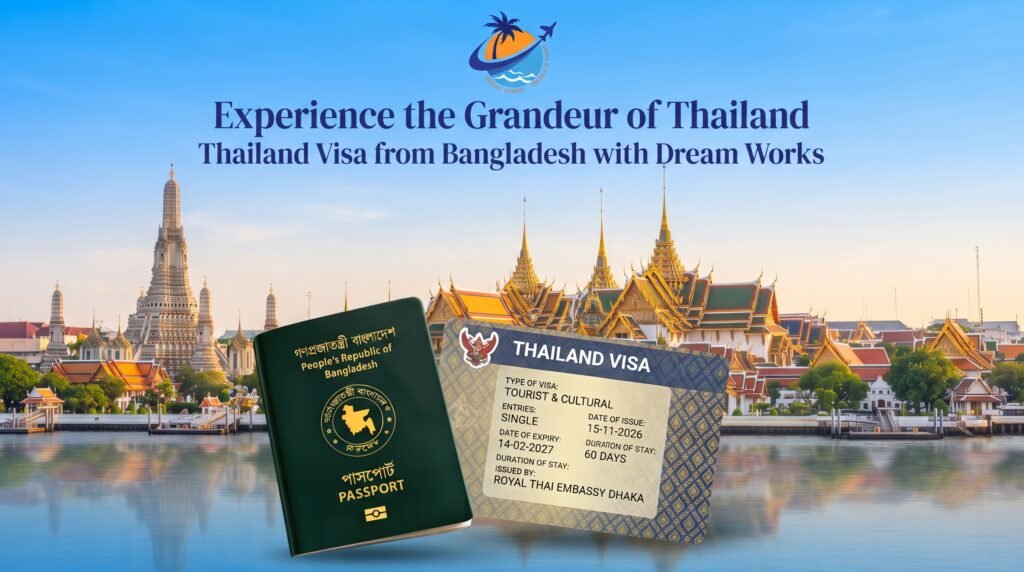
The paradigm of global business, independent freelancing, and professional mobility has undergone a radical transformation over the past few years. For modern executives, agency founders, marketing managers, and independent digital professionals operating out of Dhaka, the traditional office is no longer a mandatory physical requirement. Recognizing this monumental shift in how high-value work is executed, Thailand has strategically positioned itself as a premier global hub for location-independent professionals. However, with this incredible opportunity comes a complex bureaucratic framework that requires careful navigation. Securing a Thailand Visa from Bangladesh is an essential first step for professionals and discerning families looking to leverage Southeast Asia’s infrastructure, but the rules governing this process are evolving rapidly.
Historically, obtaining travel authorization for Thailand was a relatively predictable and straightforward administrative task. Today, it requires a nuanced understanding of shifting immigration policies, particularly with the introduction and subsequent refinement of the Destination Thailand Visa (DTV). Whether you are a corporate leader planning an extended operational base in Bangkok, a freelancer managing international clients from the beaches of Phuket, or a family seeking a long-term cultural immersion, understanding the exact intricacies of a Thailand Visa from Bangladesh is absolutely paramount. A rejected application does not merely result in lost embassy fees; it translates to disrupted operational timelines, wasted flight investments, and significant personal or professional friction.
In this comprehensive strategic guide, we will dissect the latest regulatory updates surrounding the Thai e-visa system, analyze the exact documentation required to ensure a frictionless approval process, and explore how professional travel management can safeguard your most valuable asset: your time. For corporate entities, freelancers, and leisure travelers alike, this guide serves as a blueprint for managing mobility and exploring the rich cultural tapestry of Thailand.
The Strategic ROI of the Destination Thailand Visa (DTV)
Before diving into the newly implemented regulatory hurdles, it is crucial to understand the intrinsic return on investment (ROI) associated with the Destination Thailand Visa. Unlike standard short-term tourist passes, the DTV was engineered specifically for a new class of global citizens. It targets remote workers, highly skilled freelancers, independent professionals, and individuals seeking long-term residency without the heavy complexities of a traditional corporate work permit. For Bangladeshi professionals seeking a Thailand Visa from Bangladesh under the DTV category, this visa opens up a highly lucrative operational theater.
Thailand offers world-class digital infrastructure, sophisticated co-working environments powered by global brands like WeWork, exceptional quaternary healthcare, and an unparalleled quality of life at a fraction of Western costs. By relocating temporarily or establishing a secondary base in Thailand, business leaders and freelancers can network with a massive international expatriate community. You can tap into new markets while maintaining core operations in Dhaka. The strategic advantage of operating in a globally connected time zone with direct flight access back to Bangladesh cannot be overstated.
Balancing Corporate Relocation and High-Value Freelancing
When evaluating the cost-benefit analysis of corporate relocation or extended business travel, the DTV provides unmatched flexibility. Traditional business visas require heavy corporate sponsorships, complex tax filings, and rigid adherence to specific commercial activities. The DTV bypasses much of this friction, allowing founders to manage their Bangladeshi enterprises remotely while enjoying the economic benefits of Southeast Asia. To understand the cultural phenomena driving this, you can look at the Wikipedia overview of the Digital Nomad lifestyle, which has deeply influenced Thai immigration policy.
However, the immense popularity of the DTV has forced the Thai immigration authorities to recalibrate their intake protocols. The objective is no longer simply to attract foreign capital, but to carefully vet incoming professionals to ensure security, compliance, and long-term economic alignment. Consequently, applying for a Thailand Visa from Bangladesh under this category now demands absolute precision. The days of submitting a loosely assembled portfolio of bank statements and basic identification are definitively over.
Critical August 31st Updates for a Thailand Visa from Bangladesh
Effective August 31st, a series of stringent new regulations and conditions were quietly but firmly implemented for all Destination Thailand Visa applications. These changes represent a significant pivot in how the Thai government screens applicants. Immigration authorities have optimized their digital screening algorithms and empowered consular officers to enforce strict compliance metrics.
The Royal Thai Embassy in Dhaka utilized its official social media channels to issue a clear, uncompromising directive to all prospective travelers and travel agencies. The core message was unambiguous: the vetting process has been elevated. If you are seeking a Thailand Visa from Bangladesh as a remote worker, freelancer, or long-term visitor, your application must meet these new thresholds perfectly. The embassy has explicitly stated that incomplete applications will no longer be held pending for additional documents; they will be outright rejected.
This zero-tolerance policy highlights the necessity of professional visa auditing. Relying on outdated internet forums or anecdotal advice from casual travelers is a recipe for operational failure. Let us comprehensively examine the two major documentary additions that are now strictly mandatory for a successful DTV application.
Mandatory Proof of Permanent Residency: Establishing Your Geopolitical Base
The first major regulatory addition for the DTV requires applicants to provide definitive, government-issued proof of their permanent residency. Immigration authorities have realized that the fluid nature of digital nomadism makes it difficult to track the legal base of remote workers. Therefore, when you apply for a Thailand Visa from Bangladesh, you must unequivocally prove that you are a legal, permanent resident of the jurisdiction from which you are applying.
The official Thai e-Visa portal has integrated specific upload fields dedicated entirely to verifying this geographical footprint. For remote workers leveraging the flexibility of the DTV, this means you cannot simply apply from a country where you hold a temporary tourist status. You must prove your roots.
What Constitutes Valid Proof of Residency in Dhaka?
For applicants submitting their files from Dhaka, this means you cannot rely on temporary rental agreements, informal address declarations, or business cards. The Thai e-visa portal now expects robust, state-backed verification. To satisfy this requirement for your Thailand Visa from Bangladesh, you must typically provide a high-resolution, verified copy of your Smart National Identity Card (NID) alongside your passport.
Furthermore, this identification must be cross-referenced with a corresponding, recent utility bill—such as an electricity, gas, or water bill—that matches the residential address on your application letter for letter. The utility bill must ideally be issued within the last two to three months. Consular officers use this specific document to verify that the applicant has a stable, taxable, and legally recognized presence in Bangladesh before granting them long-term access to the Thai ecosystem.
For executives, founders, and independent freelancers, address discrepancies are a notoriously common administrative pitfall. Often, a professional’s NID might reflect a permanent family address in a rural district, while their current utility bills reflect a modern residence in Gulshan, Banani, or Baridhara. If these documents contradict each other during a consular review, the application will almost certainly be flagged for misrepresentation or clerical inconsistency. Aligning your permanent residency documentation before initiating your Thailand Visa from Bangladesh is a critical compliance step that prevents unnecessary delays.
Enhanced Background Checks: The English Police Clearance Certificate (PCC)
The second, and arguably more complex, mandatory requirement introduced in the recent policy update is the integration of international security clearances. The Thai government now requires a formally issued, up-to-date Police Clearance Certificate (PCC) for all DTV applicants. This layer of security ensures that long-term remote workers entering the country have thoroughly vetted backgrounds, protecting the integrity of the visa program.
While obtaining a PCC is a standard procedure for permanent immigration to Western countries, its mandatory inclusion for a Thailand Visa from Bangladesh under the DTV category creates a unique bureaucratic challenge for local applicants. The certificate must be issued by the competent police authority of your home country or your documented country of permanent residence, and it must reflect your current legal status without any pending criminal liabilities.
The Language Translation Nuance
The most critical factor regarding the Police Clearance Certificate is the strict language mandate. A standard Police Clearance Certificate issued purely in Bengali is completely invalid for the Thai e-visa portal. The Thai Embassy in Dhaka has made it abundantly clear that the PCC must be presented in English to facilitate rapid review by international immigration officers.
If the original document is issued in dual languages (as some modern Bangladeshi police clearances generated via the online portal are), it may suffice, provided the English translation is prominent, accurate, and verifiable. However, if any portion of the legal clearance is strictly in Bengali, it must undergo a certified, official translation into English. Beyond simple translation, the document must often be notarized by an authorized legal entity or the Ministry of Foreign Affairs to prove its authenticity. Failing to execute this translation and notarization accurately is currently the leading cause of application rejection for those seeking a Thailand Visa from Bangladesh under the new DTV rules.
For busy marketing managers, agency owners, corporate executives, and freelancers, running between local police stations, translation agencies, and notary publics is an exceptionally inefficient use of time. The opportunity cost of managing this bureaucracy internally is massive. This is precisely where engaging a corporate-tier travel management firm transitions from being a luxury to a baseline operational necessity.
The Cost of Incomplete Applications at the Thai Embassy in Dhaka
Understanding the official stance of the Thai consular authorities is essential for managing your corporate travel risks. Through their official communications, the embassy has emphasized that applicants must independently verify the new rules and the exhaustive list of required documents prior to clicking submit.
When an application for a Thailand Visa from Bangladesh is submitted without the correct permanent residency proof or an improperly translated Police Clearance Certificate, the system is designed to reject it directly. There is no longer a grace period or an automated email requesting supplementary documents. The file is closed, the non-refundable visa fee is forfeited, and the applicant must begin the process anew.
The financial cost of a rejected visa fee is entirely negligible compared to the collateral damage it causes to a professional’s schedule. Consider the ROI of a successful application versus the fallout of a rejection. If a CEO is planning to relocate their operational base to Chiang Mai for six months to oversee a Southeast Asian market expansion, a visa rejection creates a cascading logistical nightmare. It delays flight bookings, disrupts long-term accommodation leases secured through global platforms like Airbnb, forces the cancellation of high-stakes international meetings, and strains relationships with foreign stakeholders.
Approaching a Thailand Visa from Bangladesh with a casual “do-it-yourself” mindset carries an unacceptably high risk of failure for professionals whose time translates directly to revenue. Corporate mobility requires predictability. By ensuring that every data point, translated document, and digital upload is audited by a dedicated visa processing team before submission, businesses insulate themselves from arbitrary bureaucratic delays.
Exploring Beyond the DTV: A Comprehensive Visa Strategy for Every Traveler
While the Destination Thailand Visa currently dominates the conversation for remote workers, freelancers, and digital nomads, it is vital to recognize that a comprehensive travel strategy must align the correct visa category with your specific travel intent. The Thai immigration ecosystem offers several other highly specialized pathways. Selecting the wrong category to bypass requirements is considered immigration fraud and is just as detrimental as missing a document.
The Standard Tourist Visa (TR) for Leisure and Exploration
For business leaders planning a luxury family vacation in Phuket, or executives taking a short recreational break after a demanding corporate summit in Dhaka, the standard Tourist Visa remains the most viable and efficient option. While it does not currently require a Police Clearance Certificate, securing a tourist Thailand Visa from Bangladesh still demands meticulous financial profiling. Applicants must provide robust bank statements demonstrating stable, long-term liquidity, alongside confirmed round-trip flight itineraries and verified accommodation bookings for the entirety of their stay.
To gain inspiration for your tourist itinerary, many Bangladeshi travelers follow prominent social media figures who document the realities of global exploration. For example, the cinematic storytelling of Nadir On The Go – Bangla provides excellent insights into international destinations. Similarly, seasoned globetrotters like Tanvir Opu showcase the triumphs of extensive international exploration, serving as fantastic resources for your upcoming Southeast Asian deployment.
The Non-Immigrant Business Visa (Non-B) for Formal B2B Engagement
If your operational intent is not remote work, but rather formal, localized corporate engagement with a registered Thai entity—such as signing joint venture agreements, attending specialized trade exhibitions, or auditing manufacturing facilities in Bangkok—the Non-Immigrant B visa is the legally mandated route.
This category bypasses the specific DTV remote-worker requirements but substitutes them with rigorous corporate scrutiny. It demands official, legalized invitation letters from the host company in Thailand, Thai corporate tax documents, detailed company profiles, and evidence of the business relationship between the Bangladeshi and Thai entities. Navigating the Non-B Thailand Visa from Bangladesh requires deep B2B coordination between the respective human resources and legal departments.
The Medical Treatment Visa (Non-MT) for Quaternary Healthcare
Thailand’s advanced healthcare infrastructure attracts thousands of Bangladeshi patients annually for complex oncology, cardiology, and elective procedures. A medical Thailand Visa from Bangladesh requires formal referral documentation from a local Bangladeshi physician and a certified acceptance letter from a recognized Thai hospital detailing the clinical schedule, treatment plan, and estimated recovery duration. Ensuring these medical files are processed with urgency is a specialized service that prevents critical delays in patient care.
Formulating a Fail-Proof Application Strategy in 2026
Given the strict enforcement of the new regulations, how can corporate applicants, independent freelancers, and families guarantee a smooth processing experience? The answer lies in systematic dossier preparation, relentless attention to detail, and pre-submission auditing.
First, conduct a preliminary document audit long before you intend to travel. Gather your primary identification and ensure your passport has at least six months of validity beyond your intended return date, with multiple blank pages remaining. Second, align your geopolitical footprint. Cross-reference your Smart NID with your most recent utility bill. If there is a discrepancy, you must resolve it locally before applying for your Thailand Visa from Bangladesh.
Third, initiate the Police Clearance Certificate process as early as possible. Background checks take time, and navigating the local police portals requires patience. Once received, immediately secure a certified English translation and notarization. Finally, digitize your documents with extreme precision. The Thai e-visa portal requires high-resolution, perfectly cropped digital uploads. Blurry scans, shadow-cast photographs, or documents exceeding file size limits will stall the application algorithm, leading to frustrating technical rejections.
For an independent freelancer or a family, managing these administrative steps is daunting. For a corporate executive, it is a fundamentally inefficient allocation of resources.
[Image Placement Suggestion: A highly organized executive desk showing a Bangladeshi passport, a digitally translated PCC document, a premium flight boarding pass, and a tablet displaying the Dream Works Travels & Tours portal, symbolizing seamless travel management.]
Seamless Travel Logistics with Dream Works Travels & Tours
At Dream Works Travels & Tours, we do not view visa processing as a standalone administrative task; we view it as the foundational layer of your global mobility strategy. We recognize that for our diverse clientele—comprising industry founders, remote work pioneers, marketing directors, and discerning families—efficiency, absolute discretion, and operational accuracy are paramount.
When you entrust us with your Thailand Visa from Bangladesh, you are not simply hiring a clerical form-filling service. You are partnering with a dedicated travel management firm that conducts a forensic, multi-point audit of your entire profile before it ever touches a government server. Our visa strategists are intimately familiar with the latest DTV requirements, including the exact translation standards demanded for the Police Clearance Certificate and the nuanced proofs of permanent residency that satisfy consular officers in Dhaka.
Our End-to-End Mobility Ecosystem
Securing your travel authorization is merely the beginning of the journey. Our agency provides a holistic travel ecosystem designed to eliminate friction at every single touchpoint of your deployment.
Once your Thailand Visa from Bangladesh is approved, our specialized air ticketing desk leverages global distribution systems to secure optimized flight routes. We ensure you travel with premium international carriers that align with your executive schedule, loyalty programs, and baggage requirements. We handle the complex routing so you can focus on your upcoming meetings or your family vacation.
Furthermore, for remote workers and executives leveraging the DTV, we offer customized long-stay travel solutions. We coordinate verified, high-speed internet-enabled accommodations in digital nomad hotspots like Sukhumvit, Nimmanhaemin, or beachfront villas in Koh Samui. We understand that your accommodation must double as a high-functioning workspace, and our curated properties reflect those high standards.
For enterprise teams, board members, and affluent families, our bespoke tour packages integrate everything from private airport transfers to exclusive cultural excursions and VIP fast-track immigration services. We ensure your time in Thailand is focused entirely on your core objectives, whether they be commercial growth, high-level professional networking, or unparalleled leisure.
Frequently Asked Questions (FAQ) About Thai Visas in 2026
To further clarify the shifting landscape of Thai immigration for Bangladeshi passport holders, we have compiled the most critical inquiries our corporate desk receives daily:
1. How long does it take to process the Destination Thailand Visa (DTV) in Dhaka? Since the implementation of the new August rules and the e-visa portal, processing times can vary. However, a meticulously prepared, error-free application generally processes within 5 to 15 working days. Delays almost exclusively stem from poorly scanned documents or translation errors.
2. Can I apply for the DTV if my Police Clearance Certificate is only in Bengali? No. The Royal Thai Embassy strictly mandates that the PCC must be in English. If your local police station issues it in Bengali, it must be officially translated and notarized before it is uploaded to the e-visa portal. Submitting a Bengali-only document will result in an automatic rejection of your Thailand Visa from Bangladesh.
3. Do I need to show a minimum bank balance for the DTV? Yes. The DTV requires applicants to demonstrate significant financial stability. You must provide authenticated bank statements showing a consistent balance equivalent to at least 500,000 THB (approximately BDT 1.7 million) to prove you can sustain yourself as a remote worker without seeking local employment.
4. Can my spouse and children accompany me on the DTV? Absolutely. The Destination Thailand Visa allows the primary applicant’s legal spouse and legitimate children (under 20 years of age) to apply for DTV dependent visas, making it an exceptional choice for executive families or successful freelancers relocating for the medium term.
5. What happens if my utility bill address does not match my NID? This is a major red flag for the e-visa portal. You must provide a formal, notarized explanation or utilize a secondary government document (like a driving license or tax certificate) that bridges the gap. Consulting with our visa strategists is highly recommended in this scenario to prevent a refusal when applying for your Thailand Visa from Bangladesh.
Final Verdict: Protect Your Time and Travel Investments
The regulatory landscape governing international travel is becoming increasingly sophisticated and data-driven. The Thai government’s decision to implement stricter residency proofs and comprehensive background checks for the Destination Thailand Visa is a clear, undeniable indicator that immigration authorities are prioritizing highly vetted, legitimate professionals.
For Bangladeshi applicants—especially corporate leaders, high-earning freelancers, and leisure travelers—the margin for error has been permanently eliminated. Incomplete files, poorly translated documents, and mismatched residential addresses will result in immediate rejection, costing you time, money, and operational momentum. Navigating this environment requires much more than simply reading an embassy social media post; it requires dedicated institutional expertise.
By partnering with a professional travel management firm, you mitigate the risks of administrative failure and secure your mobility. A properly executed Thailand Visa from Bangladesh unlocks one of the most vibrant, economically advantageous, and culturally rich hubs in the entire Asian continent. Do not leave your international mobility, or the mobility of your family and executive team, to chance. Align your travel strategy with experts who treat your journey with the exact level of precision, accountability, and professionalism that you apply to your own business.